
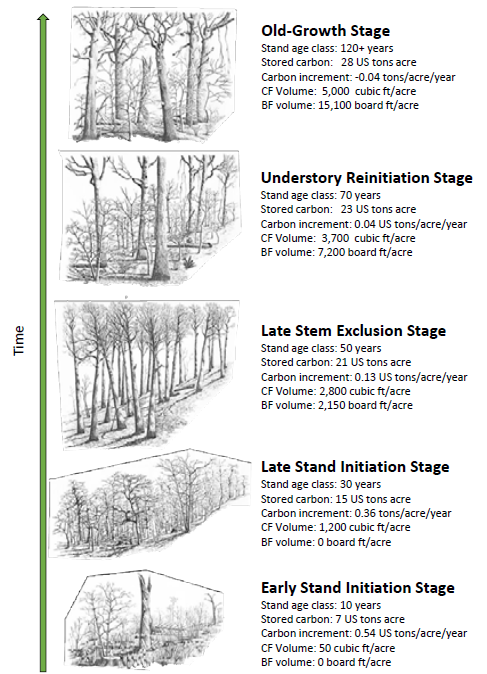
A forest stand is a spatially contiguous management unit comprised of trees of reasonably similar age, species composition, and structure, and site conditions. Stands are typically 10 to 100 acres, and most forest management activities are planned and implemented at the stand level. Thus, it is important to understand how stand-scale carbon sequestration and emissions change over time as stands age with and without disturbances, including stand management activities.
After a stand-initiating disturbance (e.g., a new stand is established following a harvest, wildfire, damage or disease), the new trees typically have ample growing space and grow rapidly. Through photosynthesis, the trees sequester and store carbon as they increase in size. Rapid increases in wood volume, biomass, and stored carbon continue through age class 50. After age class 50, the annual increase in stored carbon gradually diminishes.
This general pattern of biomass accumulation is common in stand growth. A new stand begins to accumulate carbon as it grows. As the stand ages, competition intensifies among trees, competing for growing space, and poorly adapted trees are crowded out by competitors. Well-adapted trees continue to increase in size. As the stand increases in stocking and age, it gradually approaches carrying capacity of the site. Additional increase in stand biomass are generally offset by death of other trees in the stand.
Thus, as a management protocol, keeping a forest stand protected from disturbance allowing the trees to increase in size will allow the stand to accumulate a relatively large quantity of stored carbon. However, the annual rate of carbon accumulation declines with increasing age and approaches zero for the oldest age classes.
In short:
- Young forest stands – high rate of carbon sequestration, low amount of total stored carbon
- Old forest stands – low (and possibly zero) rate of carbon sequestration, high amount of total stored carbon
Stands with large quantities of biomass (old stands) are at some risk of losing their stored carbon through disturbances. Insects, diseases, and severe weather and wildfires can quickly turn carbon stored in live trees to carbon in dead trees that emit carbon dioxide back into the atmosphere through decay. This carbon, absorbed over many decades, will take many decades to replace. Thus, attention to forest health and protection is essential part of managing stored carbon.
Timber harvesting is also a forest disturbance that affects carbon storage. Unlike unwanted disturbances, harvesting is controlled by forest managers and harvested carbon is not necessarily released into the atmosphere by decay. The carbon is harvested trees can still be stored in wood products.