
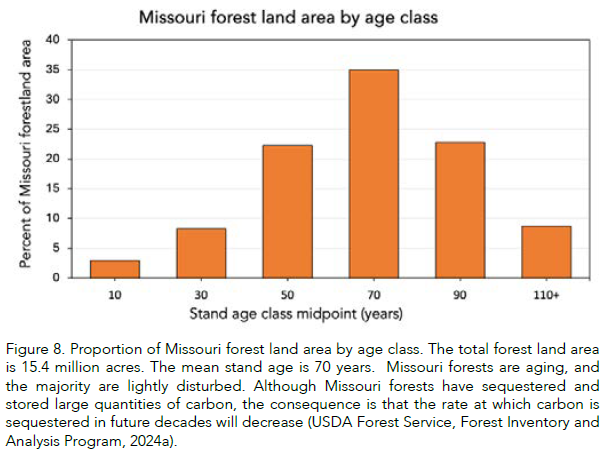
For those interested in managing forests to sequester and store carbon at the landscape scale, the patterns of annual and total carbon accumulation present a conundrum. It is impossible to simultaneously maximize the annual rate of carbon sequestration and the total accumulated stored carbon in the forest.
Persistent management for old forest conditions would result in a landscape populated by only old forests that have the maximum amount of stored carbon but would not be able to absorb any additional carbon. Alternatively, persistent management for rapid annual sequestration would require keeping total carbon stocks low, and result in many young stands.
Missouri’s forests are already old (see image). In the absence of forest management or large-scale disturbances, the tendency will be for existing forests to continue o age over the next several decades and gradually accumulate large carbon stocks, while the annual rate of sequestration will decline.
Given multiple forest management objectives and the complexity of forest management, it is hard to conceive a situation that would heavily favor either all young forests that sequester a lot of carbon, or all old forests that store a lot of carbon. Moreover, managing forests for the sole objective of maximizing either stored carbon or sequestering carbon is unlikely to create and maintain forest structure that benefits wildlife habitat, conservation, recreation, timber production, and other desired objectives. However, managing for healthy and vibrant forests can accomplish multiple objectives that include carbon accumulation.